
What makes a fundraiser truly successful? You can have all the passion and planning in place, but without a roadmap to track your goals, momentum eventually stalls. This is where a fundraising goal tracker comes in handy.
Helpful tools such as fundraising thermometers, tracking templates, and easy-to-use fundraising tracking software, are used to visually track campaigns and keep everyone involved excited to cross the finish line.
So, what is the best way to track fundraising goals? How effective are fundraising goal trackers?
Great questions! If you’re ready to crack the code to successful fundraising, then this guide is for you. You’ll learn how useful a goal tracker is and you’ll discover a variety of fundraising tracking ideas, including a free goal tracker template, to help you hit your next target.

What Is a Fundraising Goal Tracker & Why Does It Work?
Why Should I Set & Track Fundraising Goals?
Setting a fundraising goal isn’t just about having an aim. It creates motivation, sets expectations, and provides a clear vision for your team and supporters.
Motivation & Engagement
A specific goal can galvanize your team and supporters. It creates a shared focus and encourages more participation and enthusiasm.
Measuring Success
With a clear target, you can effectively measure the success of your fundraiser. This helps in understanding what works and what doesn’t, enabling you to refine your strategies in the future.
Building Credibility & Trust
When supporters see that you have a clear goal and a plan to reach it, they are more likely to contribute towards your cause.
So, how do goal trackers work to improve the success of fundraising campaigns?
It’s all about psychology. Let us explain.
Goal Gradient Effect & Fundraising Goal Trackers
Researchers call the response to the visual cue the ‘goal gradient effect’, which means people increase effort as they get closer to a finish line.
For example, when a supporter sees that your PTA is 80% of the way to funding new playground equipment, they’re far more motivated to reach the goal and donate. That “almost there” momentum has helped countless school groups, sports teams, and nonprofits close funding gaps faster.
You can’t deny the science. Of all the different types of fundraising tools, a fundraising goal tracker is a must-have asset for your organization!
What Metrics Should You Track?
- Your target amount
- The current total
- A visual representation of progress (like a bar or thermometer fill)
- Donor count, if possible
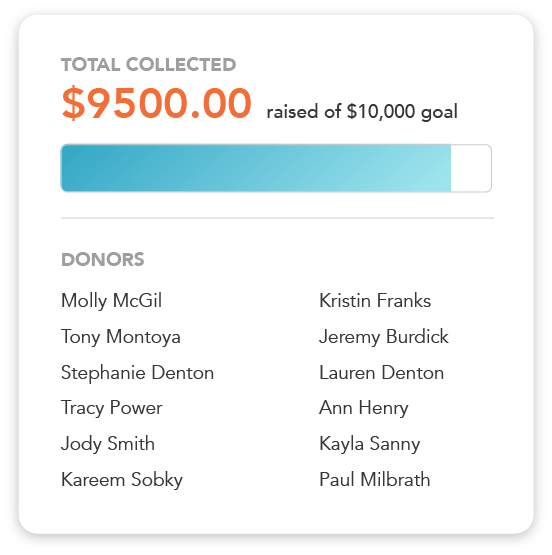
Showing donor count alongside dollars raised creates social proof, signaling that real people in the community are participating.

Pro-Tip:
For more advanced campaigns, consider displaying your average gift size and days remaining. These details create urgency and give potential donors a reference point for how much to contribute.
What Metrics Should You Track?
Not every tracker suits every campaign. The right choice depends on your audience, your fundraising channel (online, in-person, or both), and how often you can update progress.
Here are six approaches ranging from classic to creative, each with practical tips for implementation.

The Classic Fundraising Thermometer Template
The fundraising thermometer template remains popular for good reason: everyone instantly understands it.
A vertical bar “fills up” with color as donations come in, giving supporters a clear snapshot of where the campaign stands. This format works beautifully for hallway displays, event signage, and website sidebars alike.
To create a physical version, print a large thermometer outline on poster board and color it in with markers each time you hit a new increment.
For digital versions, free tools like Canva and Google Slides offer editable thermometer templates you can update and share across social media.
Pro-Tip:
The key to tracking fundraising success with this format is setting visible milestones at 25%, 50%, and 75% so supporters celebrate small wins along the way.

The Interactive Digital Progress Bar
If your fundraising campaign runs primarily online, an embedded progress bar on your collection page gives donors real-time feedback the moment a contribution processes.
Unlike a static thermometer you update manually, a digital progress bar connected to your payment platform refreshes automatically. This eliminates the lag between receiving a donation and displaying it, which keeps momentum high.
When building a nonprofit fundraising plan, factor in which platform will host your digital tracker. Look for fundraising tracking software that includes a digital progress bar so you don’t need to code anything yourself. The best options let you set your target amount during setup and then display a branded progress bar that updates with each transaction.


The Team-Based Leaderboard
Gamification turns passive donors into active competitors. A leaderboard tracker works especially well for peer-to-peer fundraising, read-athons, walk-athons, and any event where multiple teams or classrooms collect pledges simultaneously. Each team’s total appears in a ranked list, and the friendly competition drives everyone to recruit more donors.
For a more polished approach, fundraising platforms with peer-to-peer features let participants share personal fundraising pages that roll up into an automatic leaderboard. If you’re exploring peer-to-peer fundraising ideas, pairing them with a visible leaderboard can dramatically amplify engagement.
Pro-Tip:
Use these fundraising templates to take advantage of features like peer-to-peer leaderboards, progress tracking, and donor walls.

The Milestone Map
A milestone map breaks your total goal into smaller, much more tangible achievements that each unlock something meaningful.
Think of it like a board game path: each stop represents a funding milestone tied to a specific outcome. For example, a sports team raising $1,000 for new uniforms might map it as $250 for jerseys, $500 for shorts and socks, $150 for warm-up gear, and $100 for a team banner.
This tracker idea works because it answers the donor’s unspoken question: “What will my money actually do?”
By connecting dollar amounts to concrete items, you reduce donation hesitation. Display the map in your email updates, on your campaign page, and at events.

The Puzzle Wall or Brick Wall Display
For in-person campaigns, physical displays that donors interact with create a sense of ownership. A puzzle wall starts as an empty outline. Each donor (or each donation increment) earns a puzzle piece placed on the wall. A brick wall works the same way: donors write their name on a paper brick that fills a wall display. When the wall is complete, the goal is met.
This approach thrives in schools, churches, and community centers where foot traffic is high. Supporters see the wall filling up every day, which maintains top-of-mind awareness for the campaign.
It also combines tracking fundraising success with public recognition, since donors see their name as part of the collective achievement. Pair the physical display with a digital photo shared on social media each week to extend reach beyond your building’s walls.

The Dedicated Fundraising Tracking Software
One of the best ways to track your fundraisers is to use fundraising tracking software built for a variety of groups and organizations.
Why? While manual tracking with spreadsheets can work for small campaigns, it introduces errors and drains volunteer time. This problem only escalates as your campaigns grow larger.
Dedicated fundraising tracking software automates the numbers so you can focus on donor relationships.
Tools like Cheddar Up offer…
Fundraising Goal Tracker: Your Companion in Achieving Targets
Cheddar Up understands the importance of goal-setting in fundraising. And that is why we offer an intuitive fundraising goal tracker feature. It’s designed to help you keep track of your progress and engage with your supporters effectively with:
Real-Time Tracking
Watch your progress in real-time. This immediate feedback loop is not just informative but also incredibly satisfying and motivating.
Visual Representation
Our fundraising goal tracker provides a visual representation of your progress. This makes it easy for your team and supporters to see how close you are to reaching your goal.
Shareable Progress
Easily share your progress on social media or through emails, increasing transparency and trust among your supporters.
Engagement Tool
Use the tracker as a tool to engage and re-engage donors. Regular updates on progress can inspire additional donations, especially as you get closer to your goal.
Did you know:
Fundraisers that use the goal tracker raise much more than those that don’t.
How to Leverage Your Fundraising Goal Tracker to Boost Efforts
Here are some strategies to utilize a fundraising goal tracker to its fullest:
Milestone Celebrations:
Use the tracker to set and celebrate milestones. This keeps the momentum going and acknowledges the efforts of your supporters.
Transparency:
Regularly update your donors about the progress. This builds trust and can often lead to repeat donations.
Urgency Creation:
As the deadline approaches, use the tracker to create a sense of urgency. A “countdown” can encourage last-minute donations.
Feedback Loop:
Post-fundraiser, use the data from the tracker to provide feedback to your team and supporters. Share what was achieved thanks to their contributions.
Set Your Fundraiser Up for Success with Cheddar Up
In fundraising, goals are the heartbeat of your campaign. They provide direction, motivation, and a measure for success. By leveraging a fundraising goal tracker, you’re embarking on a strategic journey towards achieving your target. Remember, a well-set goal with a clear tracking mechanism can turn the aspiration of fundraising into a reality.
Whether you go with a classic thermometer on a hallway wall or opt for fundraising tracking software like Cheddar Up, the act of showing progress changes how donors relate to your cause.
If you’re ready to automate your fundraising tracking so you can spend less time on spreadsheets and more time connecting with donors, join us for a live learning session or explore Cheddar Up’s online fundraising tools to launch a campaign with built-in progress tracking in minutes!
Frequently Asked Questions
How do I choose milestone increments that keep donors motivated without feeling arbitrary?
Use increments that align with natural communication moments, such as weekly updates, event dates, or sponsor matching windows. Keep each step meaningful by tying it to a clear action, like a volunteer push or a specific outreach goal, so progress feels earned, not random.
What should I do if progress stalls and the fundraising goal tracker is not moving?
Treat a stall as a cue to refresh your offer: add a limited-time match, announce a mini-challenge, or introduce a new reason to give, such as a deadline-driven need. Then share a clear next step for supporters, like forwarding a link or asking three friends to donate.
How can we keep the fundraising goal tracker accurate when donations come from multiple channels?
Pick one source of truth, then standardize how offline gifts are recorded and when they are entered, for example every evening or after each event. If reconciliation is a recurring headache, route as many donation types as possible through a single collection method to reduce manual entry.
Is it better to show the goal publicly if we are not sure we will hit it?
Yes, as long as the goal is credible and you communicate progress honestly. If you are concerned about missing the target, consider setting a primary goal plus a secondary stretch goal so supporters still feel momentum even if the stretch is not reached.
How do we recognize donors on a public tracker without creating privacy issues?
Offer opt-in recognition choices at the point of giving, such as first name only, initials, or anonymous. For youth groups and schools, default to privacy-first options and get explicit permission before displaying any identifying information.

Get your fundraising goal tracker today
Ready to set your fundraising goals and track your progress with ease? Get started with Cheddar Up today and bring your fundraising dreams to fruition!
You may also like:

How to Host a Trunk or Treat Fundraiser
Planning a trunk or treat fundraiser for your PTA, church, or nonprofit? This step-by-step guide walks through the whole process, from setting admission and pricing trunk spots to collecting sign ups and running the event day. You can set it all up online, and this template gets you started in minutes. A trunk or treat fundraiser is a Halloween event where kids collect candy from decorated car trunks in a parking lot, while the host organization raises money through admission, trunk-spot fees, and concessions. Instead of going door to door, families walk from car to car in a designated parking area, collecting treats from creatively decorated trunks. Each participant, often called a trunker, decorates their vehicle with fun, spooky, or themed displays.
Schools, churches, PTAs, and nonprofits typically host trunk or treat fundraisers in mid- to late October. Because the whole event happens in one contained parking area rather than across a neighborhood, it’s a safe, weather-flexible way to bring the community together and support the organization.

Trunk or Treat Sign Up Sheet: Make It in 5 Minutes or Less
Create a haunting, all-in-one sign-up sheet for a trunk-or-treat event in just minutes – free! Includes registration and volunteer time slots. The most ghoulishly fun season is creeping up, which means it’s time to set up your trunk or treat sign up sheet. Building the whole thing online takes a few minutes (easily the least scary part of your season!). If you organize for a PTO, church, HOA, or scout troop, you get one place to collect attendee registrations, sign up trunk hosts and volunteers, and take payments for entry or food. This guide walks you through it with an online sign up sheet template, including how to set up registration and volunteer sign-ups on the same page. The fastest way to create a Trunk or Treat sign up sheet? Skip the blank page. Cheddar Up’s Trunk or Treat template gives you a ready-to-customize starting point with registration, donation items, waivers, and volunteer sign ups already built in. Just add your event details, make it your own, and share the link with your community.
How One PTO Raised $17K+ with a School Color Run
Melissa Knox is part of the CECA PTO at a TK-8 charter school in California. While her role focuses on social media and communications, she ended up taking the lead on one of the school’s biggest fundraisers: a Color Run Against Cancer.
The idea started with the school principal, who had previously helped organize a district-wide runathon for the American Cancer Society. The event had a great mission, but because it was held on a Saturday, turnout was low and fundraising results were limited.
The PTO saw a chance to make the event easier for families to join. Instead of asking students and parents to show up on the weekend, they brought the event right to campus during the school day. That way, every student could participate, whether they fundraised or not.
The first year, the school hosted a fun run. The next year, they added color powder and turned it into a full color run. It was simple, exciting, and easy for kids to love.
The fundraiser also tied into a larger message around healthy living. Since a portion of the money supported the American Cancer Society, Melissa and the PTO chose prizes that encouraged kids to get outside and stay active.
Incentives included jump ropes, sports balls, smoothie shop gift cards, roller rink passes, bowling gift cards, and other activity-based rewards. Every student also received a pair of sunglasses donated by a local orthodontist, so every child walked away with something fun.

How to Run a Concession Stand: Ultimate Guide & Checklist
Ready to serve up fan favorites that make the crowd go wild? Learning how to run a concession stand is your ticket to a wildly successful game day, school event, or nonprofit fundraiser. With a little upfront organization, you can transform your booth into a buzzing hub of excitement and a major moneymaker for your team or club that parents and volunteers will absolutely love working at.
This complete guide walks you through every step of setting up a concession stand for schools, booster clubs, youth sports teams, and fundraisers. You’ll receive all of the best concession stand tips, including how to pick your menu, recruit and schedule volunteers, handle payments smoothly, and avoid the mistakes that cost groups money every season.
Whether this is your first concession stand or you’re overhauling a tired setup, you’ll leave with a complete process, including a helpful concession stand checklist, that you can hand off to next year’s organizer.
Tags: